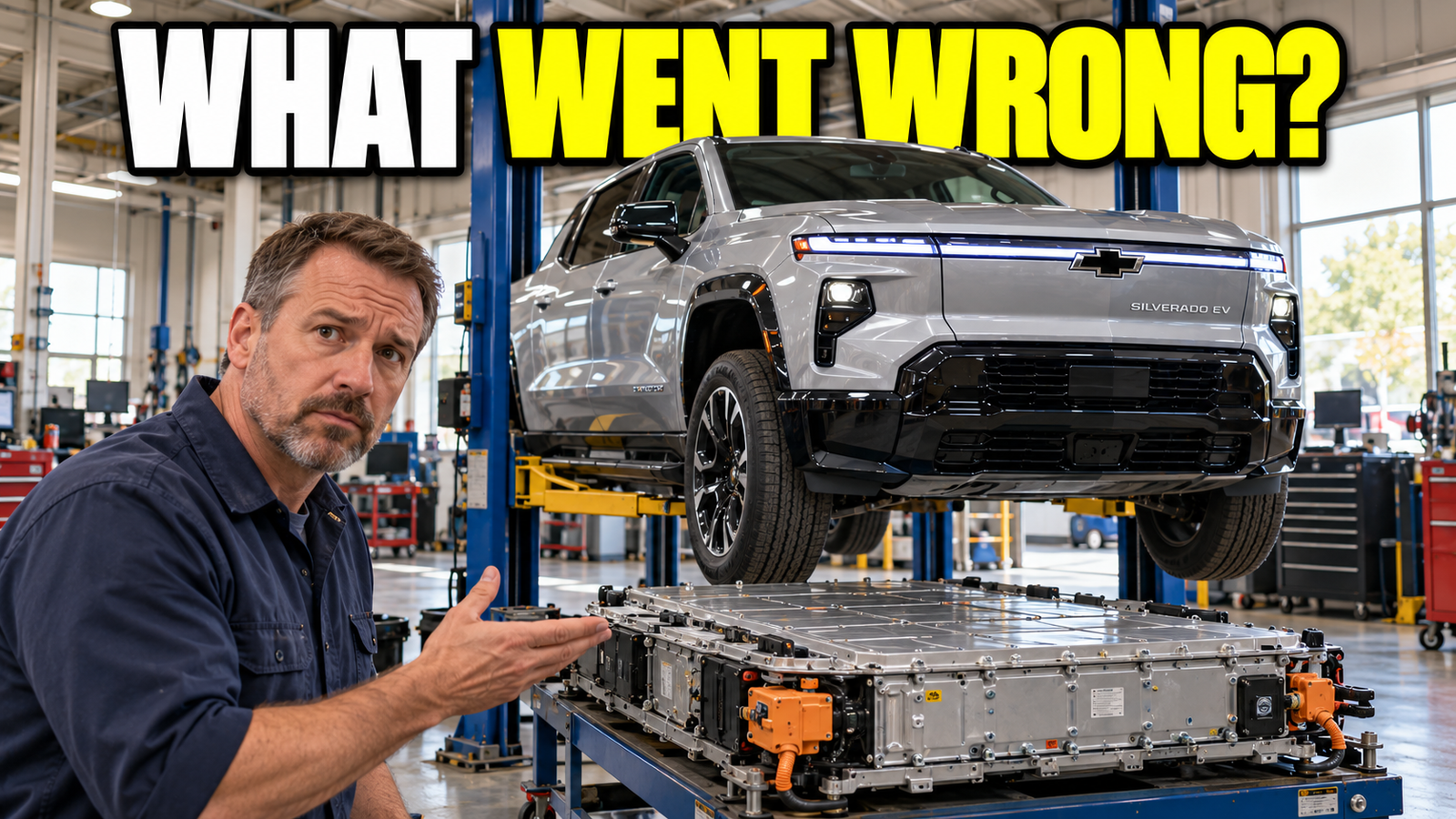
Engineers Tore Down the Silverado EV to Find Why Nobody’s Buying It — and GM Never Saw It Coming
The Chevrolet Silverado EV was supposed to prove that General Motors could build an electric pickup without making traditional truck buyers sacrifice what they loved about their gasoline-powered Silverados. It had the horsepower, the technology, the towing capability, and one of the longest driving ranges in the electric truck market.
But there is a problem that all that engineering has struggled to solve: getting enough Americans to buy one.
By the third quarter of 2026, Chevrolet Silverado EV deliveries in the United States had fallen to just 1,655 trucks, down from 3,940 during the same period the previous year. That is a 58 percent decline. Over the first nine months of the year, deliveries dropped 43.2 percent compared with 2025.
Meanwhile, Chevrolet delivered more than 100,000 conventional Silverado light-duty pickups in that same third quarter.
Those numbers raise an uncomfortable question. How did one of the most technologically ambitious pickups in GM’s history end up attracting such a small fraction of the customers who continue buying the gasoline version?
To understand what went wrong, it helps to look beneath the Silverado EV’s bodywork. The engineering decisions that make this truck impressive also explain why selling it has become so difficult.
And the biggest surprise is that the problem is not a lack of engineering talent.
The Battery Explains More Than You Might Expect
Start with what sits underneath the floor.
The Silverado EV was engineered around an enormous battery pack, and the size of that pack is central to almost everything the truck does.
The largest configurations use approximately 205 kilowatt-hours of battery capacity. That is far more energy storage than most electric passenger vehicles carry.
GM had a reason for going so big.
A conventional pickup can refill its fuel tank in minutes. An electric pickup needs to carry enough stored energy to make long trips, haul equipment, and tow trailers without constantly stopping to recharge.
That creates an engineering challenge unlike the one faced by electric sedans or compact SUVs.
The Silverado EV needs enough battery capacity to move a large vehicle at highway speeds, often with passengers, cargo, or a trailer attached. Its battery also has to deliver substantial power for acceleration and maintain safe temperatures while doing demanding work.
The result is a sophisticated system involving battery modules, cooling equipment, heavy-duty electrical connections, structural protection, and advanced battery-management electronics.
Every part adds cost.
The same large battery that helps the Silverado EV deliver outstanding range also makes it expensive to manufacture.
That is the fundamental contradiction at the center of GM’s electric pickup strategy.
The Silverado EV Is Carrying a Lot of Weight
The physical size of the battery leads directly to another problem.
Weight.
In MotorTrend’s testing, a 2026 Silverado EV Trail Boss equipped with the Max Range battery weighed 8,778 pounds.
For perspective, that is substantially heavier than many gasoline-powered half-ton pickups.
The extra mass comes with consequences.
Suspension components must support the vehicle’s weight. Tires need to handle enormous loads. Braking systems must safely manage the momentum of a very heavy truck. Engineers also have to account for how weight affects handling, efficiency, payload, and off-road performance.
MotorTrend found that the 2026 Trail Boss delivered impressive acceleration and range, but its considerable weight contributed to disappointing performance in certain off-road situations.
The test truck struggled over obstacles that lighter vehicles could handle more easily.
None of this means the Silverado EV is poorly engineered.
In fact, getting a vehicle this heavy to accelerate so quickly while delivering hundreds of miles of driving range is a significant engineering accomplishment.
But those accomplishments are expensive.
And customers ultimately pay for them.
GM Built a Different Truck Under a Familiar Name
One of the most important things about the Silverado EV is that it is not simply a conventional Silverado with its gasoline engine removed.
The electric model uses a dedicated vehicle architecture developed for electric propulsion.
The traditional Silverado 1500 relies on decades of engineering refinement, established manufacturing processes, and a supply chain designed around internal-combustion trucks.
The Silverado EV requires a different structure, battery integration, electric motors, power electronics, and thermal-management systems.
Even the packaging is different.
The electric pickup takes advantage of its dedicated platform to offer distinctive features, including available four-wheel steering, advanced power delivery, and a Multi-Flex Midgate that can extend the usable cargo area into the cabin.
These are genuinely useful innovations for certain buyers.
But a dedicated architecture also represents a huge financial commitment.
Factories need specialized equipment. Employees require training. New components must be developed, tested, and sourced. Suppliers must meet demanding production requirements.
Those investments are easier to recover when a vehicle sells in large quantities.
When sales are limited, spreading development and manufacturing costs across relatively few trucks becomes more challenging.
That does not prove every Silverado EV is sold at a loss. GM does not publicly provide a simple, model-specific profit figure that would support such a conclusion.
It does, however, explain why manufacturing scale matters so much to the economics of electric pickups.
The Price Is Where the Argument Gets Difficult
The electric Silverado’s engineering may be impressive, but customers do not buy trucks based on engineering achievements alone.
They compare prices.
Chevrolet’s 2026 Silverado EV lineup has included entry-level versions priced in the mid-$50,000 range, while more expensive configurations climb well beyond $70,000.
In MotorTrend’s test, the Silverado EV Trail Boss carried a base price of $72,095. The particular truck being tested cost $94,450.
That is serious money.
At those prices, the Silverado EV competes not only with other electric pickups but also with well-equipped gasoline trucks, heavy-duty pickups, and premium SUVs.
Many traditional Silverado buyers already have a vehicle that meets their needs.
It tows their boat. It carries construction materials. It handles long highway drives and can be refueled almost anywhere.
Persuading those customers to spend thousands more requires a compelling financial or practical advantage.
Electric motors offer excellent torque and smooth acceleration. Home charging can be convenient, and electricity costs may be lower than gasoline costs depending on local rates and driving habits.
But purchase price remains a major obstacle.
A customer who drives relatively few miles each year may take a long time to recover a significant upfront premium through lower operating costs.
For a business with predictable routes and inexpensive overnight charging, the calculation may be different.
The Silverado EV therefore makes more economic sense for some buyers than others.
And that helps explain why its potential customer base is narrower than the market for conventional Silverado trucks.
Towing Reveals a Difficult Trade-Off
The Silverado EV can tow serious weight.
Properly equipped 2026 configurations offer a maximum towing rating of 12,500 pounds, making the truck capable of handling demanding jobs.
But towing capacity and towing range are not the same thing.
The electric motors can produce the torque needed to pull a trailer. The difficult part is maintaining driving range while doing it.
A large trailer creates substantial aerodynamic resistance. At highway speeds, that extra drag requires considerably more energy.
A pickup that travels hundreds of miles on a single charge without a trailer may need much more frequent charging stops when towing a heavy load.
MotorTrend’s 2026 Silverado EV Trail Boss testing demonstrated impressive highway range, with the vehicle traveling approximately 395 miles in its road-trip test without a trailer.
Yet the publication noted that towing can roughly halve an electric pickup’s range, depending on the conditions and load.
That creates practical complications for owners who tow regularly.
Charging stations may not have enough room for a pickup and trailer together. Drivers might have to disconnect their trailers before charging. Long journeys require more planning, and charging availability becomes particularly important in rural areas.
The Silverado EV’s available 350-kilowatt fast-charging capability helps address this problem.
In MotorTrend’s test, the truck recovered an estimated 220 miles of driving range during a 30-minute charging session.
That is excellent performance for such a large electric vehicle.
Still, it requires a compatible high-power charger under suitable conditions. It does not deliver the same experience as pulling into a gasoline station, filling a tank, and continuing down the highway.
For some owners, that difference is minor.
For others, it changes whether the truck fits their lives.
The Sales Numbers Make the Problem Impossible to Ignore
The Silverado EV’s sales history deserves a closer look because the story is not simply one of constant decline.
During the third quarter of 2025, GM delivered 3,940 Silverado EV pickups in the United States, nearly double the number delivered in the comparable quarter of 2024.
That demonstrated genuine interest in the product.
But the market changed.
In the third quarter of 2026, Silverado EV deliveries fell to 1,655 units. By comparison, conventional Silverado light-duty deliveries climbed to 100,221 units during the same period.
The contrast is striking.
GM was still selling plenty of trucks. Americans had not suddenly stopped buying pickups.
They were overwhelmingly choosing conventional Silverados over the electric version.
The broader electric-vehicle market was also experiencing turbulence, particularly following changes to federal purchasing incentives and shifts in consumer demand.
Those external factors matter. It would be misleading to blame the entire decline on the Silverado EV’s engineering.
Nevertheless, the figures show how difficult it has become for the electric model to compete with the established truck market.
Chevrolet was not struggling to convince Americans to buy the Silverado name.
It was struggling to convince enough of them to buy the electric Silverado.
That distinction matters.
The Technology Is Better Than the Sales Suggest
Here is where the story becomes more interesting.
The Silverado EV is not an incapable vehicle.
Independent testing has demonstrated strong acceleration, excellent driving range, competitive fast-charging performance, and genuine towing capability.
Its available Midgate provides cargo flexibility. Its dual-motor drivetrain offers substantial torque. Its available onboard power can be useful on job sites, during camping trips, or for powering equipment.
In other words, there is a lot to like.
The truck’s biggest challenge is not that it fails to perform the basic tasks of a pickup.
It is that its benefits come with trade-offs that many buyers are reluctant to accept.
Long driving range requires large batteries.
Large batteries add weight and cost.
High prices reduce the pool of potential customers.
Lower sales volumes make it more difficult to achieve the economies of scale needed to reduce costs.
This cycle is one of the biggest problems confronting the electric pickup business.
And it cannot be solved by adding more horsepower or installing a larger touchscreen.
GM Is Trying to Fix the Economics
General Motors has already taken steps to make the Silverado EV more accessible.
The company expanded its range of battery configurations and introduced less expensive versions intended to reach a broader group of customers.
Cheaper versions generally use smaller battery packs or offer different equipment.
That approach helps reduce the purchase price, but it introduces another trade-off.
A buyer choosing a smaller battery sacrifices some driving range, which may be one of the reasons they considered a more expensive electric pickup in the first place.
GM is also investing in new battery technologies.
Its work on lithium manganese-rich cells is intended to reduce reliance on expensive battery materials while maintaining the energy capacity needed for larger vehicles.
The company is targeting commercialization of that technology in 2028.
If successful, those improvements could make future electric pickups less expensive to manufacture.
But the benefits depend on successful development, manufacturing scale, and how much of the savings can ultimately be passed along to buyers.
For the Silverado EV being sold today, the underlying challenge remains.
What Engineers Can Fix — and What They Cannot
An engineering examination of the Silverado EV would reveal a vehicle built around difficult compromises rather than one obvious fatal defect.
GM can improve battery chemistry.
It can redesign components, reduce unnecessary weight, improve manufacturing efficiency, and optimize electric motors.
Those changes could eventually make the Silverado EV more affordable and easier to own.
But engineering cannot directly control electricity prices, charging infrastructure, consumer confidence, financing costs, or how often truck owners need to tow.
Nor can engineers simply make a large battery inexpensive without significant improvements in materials, production, and design.
The electric Silverado is competing against a gasoline-powered pickup that already benefits from decades of refinement.
That is a much tougher opponent than it might appear.
The Real Reason the Silverado EV Is Struggling
The most revealing thing about the Silverado EV is that its engineering strengths are closely connected to its commercial weaknesses.
The huge battery helps deliver outstanding range, but increases cost and weight.
The sophisticated platform provides impressive capability, but requires substantial investment.
The advanced electric drivetrain delivers performance that many gasoline trucks cannot match, yet many traditional buyers are unwilling to pay significantly more for those advantages.
And when towing, convenience, and price enter the conversation, familiar gasoline-powered pickups remain attractive.
GM did not build a truck that nobody wants. Thousands have been sold, and for certain customers, the Silverado EV is an excellent choice.
What the company has not yet demonstrated is that enough American pickup buyers want its electric truck at the prices and compromises currently required.
That is the real problem.
It is not hiding behind a broken component or a defective electric motor.
It is built into the difficult relationship between battery size, vehicle weight, manufacturing cost, and what customers are willing to pay.
The Silverado EV may become an important part of Chevrolet’s future as batteries improve and the economics begin to change.
But for now, the sales figures tell a story that Detroit cannot afford to ignore.
GM proved it could build an extraordinary electric pickup. The harder challenge is convincing ordinary truck buyers that they need one.