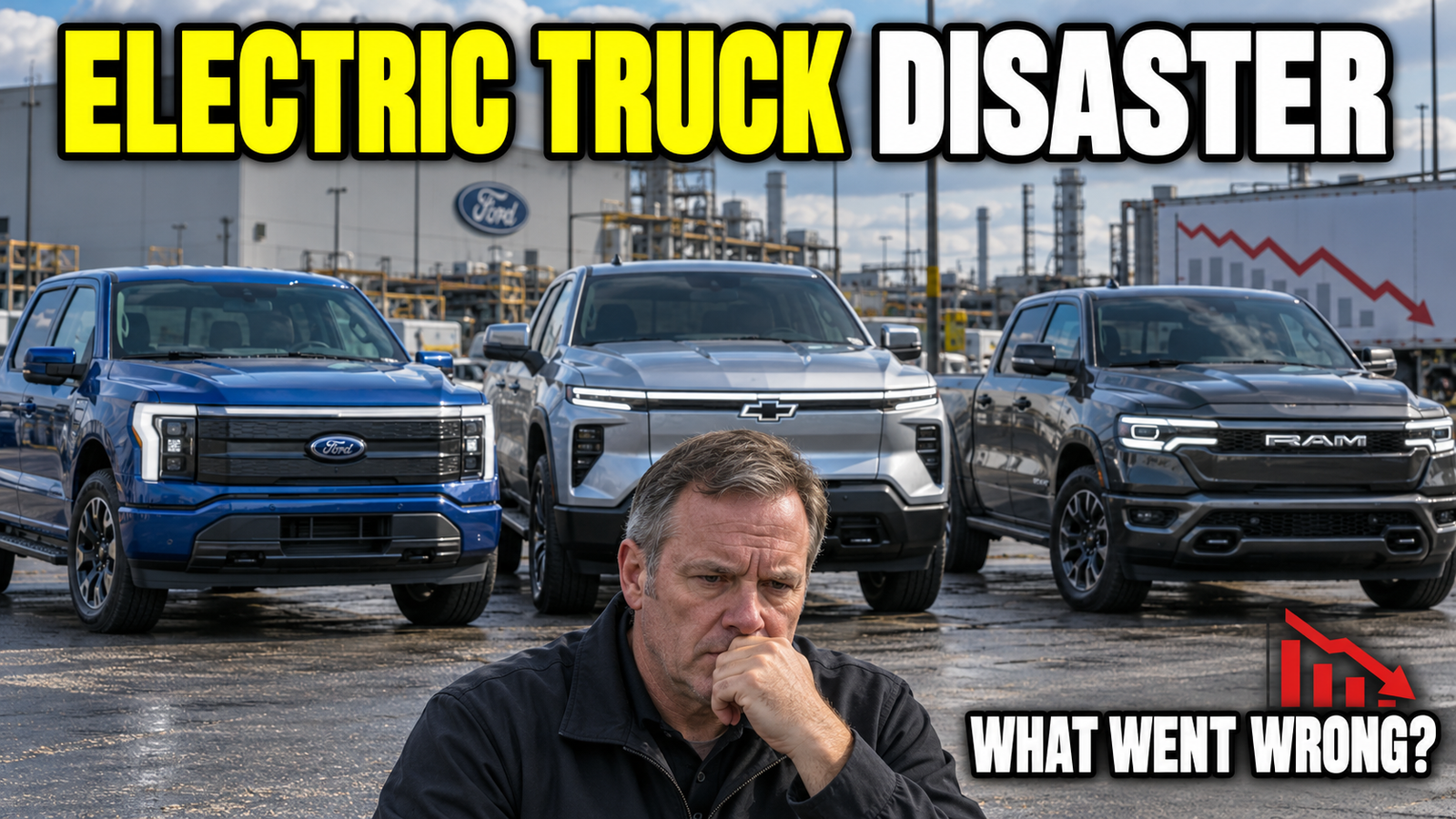
The Electric Truck Disaster: What Really Killed the F-150 Lightning, Silverado EV and Ram REV
For a moment, it looked like electric pickups were about to change the American truck market forever.
Ford unveiled the F-150 Lightning with huge excitement. Chevrolet promised a Silverado EV with massive range and futuristic capability. Ram entered the fight with bold claims of its own, positioning the Ram REV as a serious answer to both.
On paper, it all looked unstoppable.
But then reality hit.
The electric truck revolution ran into the one market it could not afford to misunderstand: full-size pickup buyers. These are customers who care less about headlines and more about price, towing, reliability, charging convenience, and whether a truck actually makes sense for daily work.
That is where things started to fall apart.
The problem was never that these trucks were slow, boring, or technologically unimpressive. In fact, most of them were the opposite. The real issue was that Detroit tried to push the future into a segment where buyers are brutally practical.
And practical buyers do not reward hype. They reward value.
The F-150 Lightning Proved Demand Was Real — But Limited
Ford deserves credit for moving first in a serious way.
The F-150 Lightning arrived with real power, smart packaging, strong branding, and the advantage of wearing America’s most famous truck name. It offered useful features like front trunk storage, exportable power, strong acceleration, and a driving experience that felt more refined than many people expected.
For early adopters, it was exciting.
But the Lightning also exposed a major problem: enthusiasm does not always translate into endless demand.
Ford expanded production and lowered prices to make the truck more competitive, which showed the company understood the challenge. That move helped keep the Lightning alive in the conversation, but it also revealed that demand at higher price points was not nearly as deep as many had hoped.
That was the first major warning sign for the electric truck segment.
Buyers liked the idea of an electric F-150. They just did not always like the monthly payment that came with it.
And in the truck world, that matters more than almost anything else.
The Silverado EV Went Too Big, Too Expensive, Too Fast
If Ford’s problem was that demand was narrower than expected, Chevrolet’s problem was even more obvious: price.
The Silverado EV is impressive. There is no denying that.
It offers huge range, major power, advanced technology, and a design that feels more like a next-generation product than a converted gas truck. In some versions, it promises range figures that would have sounded impossible just a few years ago.
But capability alone does not guarantee success.
The Silverado EV quickly became a symbol of what happens when an electric truck becomes too expensive to feel like a truck for normal people. Once pricing moves deep into premium territory, buyers start asking hard questions. If they are going to spend that much money, why not buy a luxury SUV, a heavy-duty truck, or simply keep driving a cheaper gasoline pickup that already does the job?
That is the trap.
The Silverado EV may be a technical achievement, but much of the market sees it as overbuilt, overweight, and overpriced for what most truck buyers actually need.
And when the price gap between electric and gas becomes impossible to ignore, technology stops being the headline. The price becomes the story.
Ram Saw the Warning Signs and Hit the Brakes
Ram may have been later to the game, but that delay may have helped it see what Ford and Chevrolet were already learning the hard way.
The company originally planned to bring the Ram 1500 REV to market earlier, but later shifted focus to the Ramcharger and pushed the REV behind it. That decision said a lot without needing to say everything out loud.
Stellantis effectively acknowledged what the market was already showing: demand for fully electric half-ton pickups was softer and more complicated than expected.
That is not a small detail. It is one of the biggest clues in the entire electric truck story.
The Ram REV was supposed to be part of the next wave. Instead, Ram chose to prioritize a range-extended solution that looked safer, more flexible, and easier to sell to real truck buyers who still worry about range, charging, and towing.
That move was not random. It was a response to market reality.
And market reality has been brutal.
Towing and Range Were a Terrible Combination
One of the biggest promises of electric trucks was that instant torque would make them incredible tow vehicles.
Technically, that part was true.
Electric pickups do feel strong. They launch hard, respond instantly, and often feel more powerful around town than many gasoline trucks.
But towing exposes the weakness that truck buyers care about most: range collapse.
A truck that looks great on paper without a trailer can start looking very different once real work begins. Pulling a heavy load drains battery capacity fast, and that means more charging stops, more planning, and more frustration.
For passenger EV buyers, charging can be an inconvenience. For truck buyers, especially those who tow, it can become a dealbreaker.
This is the kind of issue that looks manageable in a presentation slide and much harder in the real world.
Truck buyers do not just want enough range in perfect conditions. They want confidence. They want to hook up a trailer, turn on the air conditioning, load the family or equipment, and go.
Electric pickups still struggle to deliver that experience without compromise.
These Trucks Became Too Heavy and Too Costly
Another issue Detroit could not escape was physics.
To deliver the kind of range people expect from a full-size electric truck, manufacturers had to install massive battery packs. Those batteries are expensive, extremely heavy, and difficult to hide from the economics of the vehicle.
That creates a chain reaction.
More battery means more weight. More weight requires stronger structures, tougher suspension tuning, larger brakes, and more engineering complexity. That adds cost. Then the sticker price rises. Then the pool of buyers shrinks.
This is why electric trucks became such a difficult business case.
The companies were trying to build trucks that looked futuristic, delivered strong range, towed like traditional pickups, accelerated like performance vehicles, and still felt remotely affordable.
That combination is brutally hard to achieve all at once.
Something had to give.
And what gave was the business model.
Detroit Misread the Truck Buyer
The biggest mistake may have had nothing to do with batteries, software, or charging speed.
Detroit misread how conservative the truck market really is.
Pickup buyers are not necessarily anti-technology. Many love innovation. But they want innovation that makes the truck better without making ownership more complicated or dramatically more expensive.
The average truck buyer is not shopping for a science project. They are shopping for a tool, a work partner, a tow vehicle, and in many cases the most important machine in their daily life.
That means trust matters.
Routine matters.
Refueling speed matters.
Long-distance convenience matters.
And value matters more than almost everything else.
That is why the electric truck market did not collapse because the products were bad. It stalled because the products asked too much from buyers too soon.
Too much money.
Too much faith in charging infrastructure.
Too much compromise under load.
Too much dependence on ideal conditions.
That is not a formula for mass adoption in the truck world.
This Was Never Just About Technology
It would be easy to say these trucks failed because battery technology was not ready. But that is only part of the story.
The real issue is that the electric pickup segment arrived before the economics made sense for mainstream buyers.
The technology can be impressive. The products can be powerful. The design can be excellent.
But if the truck is far more expensive than a gas model, loses too much range while towing, and forces buyers into a charging lifestyle they do not trust yet, the market will resist it.
And that is exactly what happened.
Ford found out that first-mover advantage does not guarantee unlimited demand.
Chevrolet found out that engineering brilliance cannot hide a massive price problem.
Ram found out it was safer to rethink the plan than force a battery-electric launch into a skeptical market.
Different trucks. Different strategies. Same wall.
So What Really Killed Them?
In the end, the electric truck disaster was not caused by one fatal flaw.
It was a combination of things:
high prices,
heavy battery packs,
range anxiety under real truck use,
slow charging compared to refueling,
buyer skepticism,
and a market that simply was not ready to embrace expensive electric pickups at scale.
That is what really killed the dream — at least for now.
The F-150 Lightning did not disappear, but it proved the segment was smaller than expected.
The Silverado EV showed just how hard it is to build a great electric truck at a price real buyers can accept.
The Ram REV was delayed by the same reality before it even had a chance to fully enter the fight.
And that may be the clearest sign of all.
Detroit did not fail because it forgot how to build trucks.
It failed because it tried to reinvent America’s most demanding vehicle category before the numbers, the infrastructure, and the buyer mindset were truly ready.
The future may still belong to electric trucks one day.
But right now, the market is sending a very different message:
not yet.