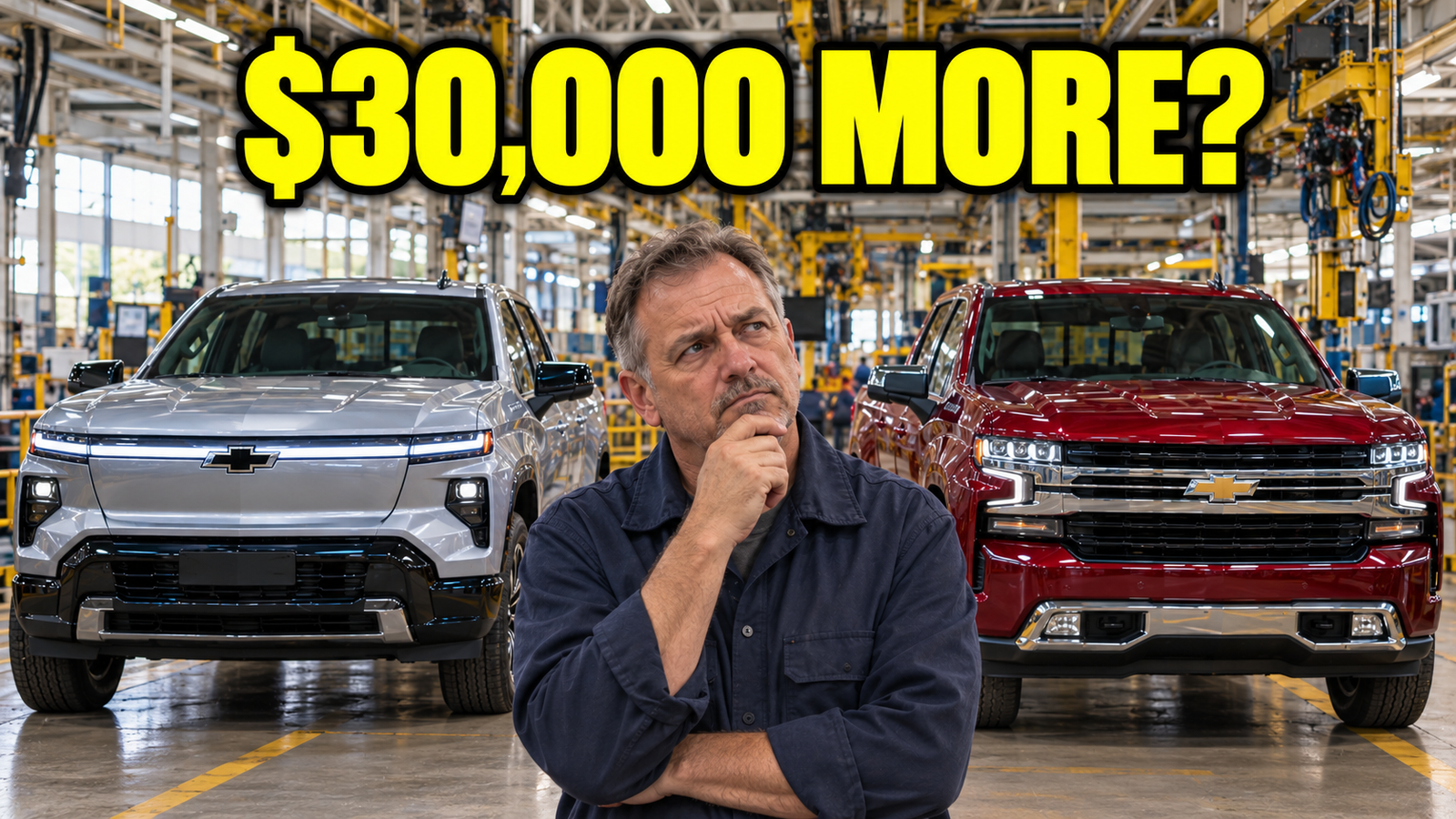
Why the Silverado EV Cost $30,000 More Than a Gas Truck, and Detroit Can’t Fix It
For decades, Chevrolet’s Silverado has represented something simple to American truck buyers: strength, reliability, and the ability to get the job done without spending a fortune on technology they never asked for.
But when General Motors turned its legendary pickup into an electric vehicle, something unexpected happened. The price of a truck that was supposed to represent the future of American transportation suddenly became one of the biggest obstacles standing in its way.
And the numbers reveal just how serious the problem has become.
Consider the 2026 Chevrolet Silverado EV Work Truck with the Extended Range battery. Its starting manufacturer’s suggested retail price was $68,295. Meanwhile, the conventional Silverado 1500 Work Truck started at approximately $37,200.
That is a difference of $31,095 between two pickups wearing the same legendary name.
The vehicles are not identical in equipment, configuration, or capability, and the least expensive Silverado EV costs considerably less than the extended-range version. But the comparison exposes a fundamental challenge facing General Motors and the broader American automotive industry.
Why does replacing a gasoline engine with electric motors and batteries make a pickup so expensive? And why has Detroit struggled to close the gap?
The answer goes far beyond batteries.
The Battery Is Where the Money Goes
The most important difference between an electric Silverado and its gasoline-powered counterpart is hidden beneath the body.
Traditional Silverado trucks use engines and transmissions built around technology General Motors has spent generations refining. Factories, suppliers, engineering processes, and manufacturing systems have been optimized to produce these components at enormous scale.
The Silverado EV, however, depends on a massive lithium-ion battery system.
And massive is not an exaggeration.
Certain Silverado EV configurations use battery packs with capacities approaching or exceeding 200 kilowatt-hours. These are exceptionally large batteries compared with those found in ordinary electric passenger cars.
That additional capacity is essential because a full-size pickup has a completely different mission from a small electric sedan.
Truck buyers expect towing capability, room for passengers and cargo, strong acceleration, and enough driving range to travel long distances without constantly worrying about the next charging station.
Delivering all those things electrically requires tremendous energy storage.
The result is expensive battery chemistry, complex temperature-management systems, heavy structural components, sophisticated power electronics, and extensive safety engineering.
Even as battery prices improve across the industry, installing such a large battery creates a substantial manufacturing cost that a gasoline-powered truck simply does not face.
And reducing that cost without sacrificing range or capability remains one of General Motors’ biggest engineering challenges.
The Silverado EV Is Not Simply a Gas Truck With Batteries
There is another reason the electric version carries such a different price.
Despite sharing the Silverado name, the two vehicles are not built on the same underlying architecture.
The gasoline Silverado 1500 uses a conventional truck platform designed around internal-combustion engines.
The Silverado EV was developed on a dedicated electric platform related to the architecture used for other large GM electric vehicles.
That means the company had to engineer much more than a different powertrain.
The electric Silverado requires its own structural design, battery integration, electrical architecture, crash protection systems, thermal-management equipment, and manufacturing processes.
Those investments require enormous amounts of money before the first truck reaches a dealership.
And when manufacturers spend heavily developing a new vehicle platform, recovering those costs becomes much more difficult if sales volumes remain modest.
This is where Detroit encounters a problem that cannot be solved simply by offering a discount.
A manufacturer can temporarily reduce the sticker price, but that does not automatically reduce the amount of money required to build the vehicle.
The Weight Problem Makes Everything Harder
The electric Silverado delivers impressive performance.
It can produce tremendous torque almost instantly, accelerate like a performance vehicle, and offer driving ranges that would have seemed unrealistic for an electric pickup just a few years ago.
Some 2026 Work Truck configurations offer nearly 500 miles of EPA-estimated range.
But achieving those numbers comes with a physical penalty.
Large battery packs are heavy.
Certain Silverado EV configurations weigh close to 9,000 pounds, significantly more than many conventional half-ton pickups.
That extra weight influences nearly every aspect of the truck.
Suspension components must handle the load. Tires must support the vehicle’s mass. Braking systems, structural engineering, and overall energy efficiency all become important considerations.
And towing introduces another complication.
In a 2025 road test, Autoweek observed that the Silverado EV’s measured efficiency fell by approximately half while towing a 4,500-pound travel trailer compared with driving a similar route without it.
That was one particular test, not a universal prediction for every towing situation. Nevertheless, it illustrates a serious challenge for electric pickups.
A truck can advertise excellent driving range under standardized conditions, but real-world towing can substantially reduce how far it travels between charging stops.
Increasing battery capacity can address range concerns, but doing so adds cost and weight.
Reducing battery size helps lower the price, but it also reduces the driving range that many buyers consider essential.
General Motors must balance these competing demands, and none has a simple solution.
Detroit Built Its Truck Business Around Gasoline
There is an important financial reality behind the Silverado name.
Traditional full-size pickups are among the most strategically important vehicles sold by American automakers.
Over decades, manufacturers developed highly efficient production systems and profitable businesses around gasoline-powered trucks.
Customers understand their capabilities. Mechanics know how to service them. Replacement parts are widely available, and the supporting infrastructure already exists.
The electric Silverado has to compete against all of that.
It must convince buyers that the benefits of electric power justify a higher initial purchase price and a different ownership experience.
For some customers, that argument is compelling.
Electric motors provide smooth acceleration and impressive torque. Home charging can be convenient. Electricity may cost less than gasoline, and electric vehicles generally require fewer routine powertrain maintenance services.
But those advantages do not erase a $30,000 purchase-price difference overnight.
A buyer must consider electricity rates, annual mileage, insurance, charging installation, towing needs, financing, and how long the truck will remain in service.
For drivers who cover relatively few miles each year, recovering a substantial upfront premium through operating savings can be especially difficult.
For commercial fleets with predictable routes and reliable depot charging, the calculation may be more favorable.
That difference between buyers is one reason the electric pickup market has proven more complicated than manufacturers initially hoped.
General Motors Has Already Started Cutting Prices
It would be inaccurate to suggest that Chevrolet has done nothing to address the problem.
The company has expanded the Silverado EV lineup and introduced less expensive configurations.
For 2026, the entry-level Silverado EV Work Truck with a Standard battery was announced at $54,895, offering an EPA-estimated 286 miles of range.
That is substantially below the price of the larger-battery versions.
The Silverado EV LT also became more accessible with the introduction of a Standard battery option.
These changes demonstrate that GM understands one of the most important barriers to electric-truck adoption.
The trouble is that a cheaper electric truck usually requires a trade-off, particularly in driving range or equipment.
The Standard Range Work Truck may be sufficient for certain drivers and fleet operators. But customers demanding more than 400 miles of advertised range must still pay considerably more.
That leaves Chevrolet attempting to serve two different audiences: buyers who want affordable work transportation and customers who want maximum electric capability.
Satisfying both at gasoline-truck prices remains extremely difficult.
GM’s Potential Solution May Not Arrive Until 2028
General Motors is not ignoring the underlying battery economics.
In May 2025, GM and LG Energy Solution announced plans to commercialize lithium manganese-rich battery cells, commonly known as LMR batteries.
These cells rely more heavily on manganese, a material that is generally less expensive than nickel and cobalt.
The technology is intended to help GM deliver long-range electric trucks while significantly reducing battery costs.
GM has also discussed alternative battery chemistries and more efficient packaging designs.
The company previously outlined how a combination of lithium-iron-phosphate chemistry and improved battery construction could potentially reduce the cost of a Silverado EV battery pack by approximately $6,000.
That is meaningful progress.
But a $6,000 reduction in battery costs does not automatically translate into a $6,000 reduction in the retail price, nor would it eliminate every price difference between electric and gasoline-powered Silverados.
More importantly, commercial production of GM’s planned LMR cells is targeted for 2028.
Until those technologies are manufactured at scale and successfully integrated into production vehicles, their promised savings remain future potential rather than an immediate solution.
That is why Detroit cannot simply flip a switch and make electric trucks as inexpensive as their gasoline counterparts.
What Happens If Buyers Keep Choosing Gas Trucks?
The challenge facing General Motors extends beyond the Silverado EV itself.
American truck buyers are famously demanding.
They want capability, dependability, convenience, and value.
For many, a pickup is not a luxury purchase. It is a tool used to support a business, transport equipment, tow trailers, or handle everyday responsibilities.
And when a gasoline-powered Silverado can perform those duties at a substantially lower purchase price, the electric model faces a difficult sales argument.
That does not mean electric trucks are destined to fail.
Battery technology is improving. Charging infrastructure continues to develop. Manufacturers are learning how to produce electric vehicles more efficiently.
For certain owners, the Silverado EV already provides capabilities that a gasoline truck cannot match as conveniently, including powerful onboard electricity delivery, quiet operation, and impressive acceleration.
But technological superiority in one area does not guarantee commercial success.
Affordability still matters.
And the companies that solve the relationship between cost, range, charging, and real-world capability will have an enormous advantage.
The Real Problem Detroit Cannot Ignore
The Silverado EV demonstrates that General Motors knows how to build a powerful, capable, long-range electric pickup.
That was never the central question.
The difficult part is building one at a price that ordinary truck buyers are willing and able to pay.
A gasoline Silverado benefits from decades of manufacturing experience, established suppliers, and an enormous customer base.
The electric Silverado represents a newer technological approach, with different components, production economics, and ownership considerations.
The approximately $30,000 gap between certain configurations captures that difference in a way almost any buyer can understand.
GM is working to narrow it, but the evidence suggests that the biggest improvements will require more than temporary discounts or minor equipment changes.
They will require cheaper batteries, more efficient manufacturing, greater production scale, and a market willing to embrace electric pickups.
Until those pieces come together, the traditional gasoline Silverado retains an advantage that no amount of electric horsepower can easily overcome.
And that leaves Detroit facing a difficult question: If an electric truck delivers the future, but costs thousands more than the truck Americans already trust, how many buyers will actually pay for it?The Electric Truck Disaster: What Really Killed the F-150 Lightning, Silverado EV and Ram REV