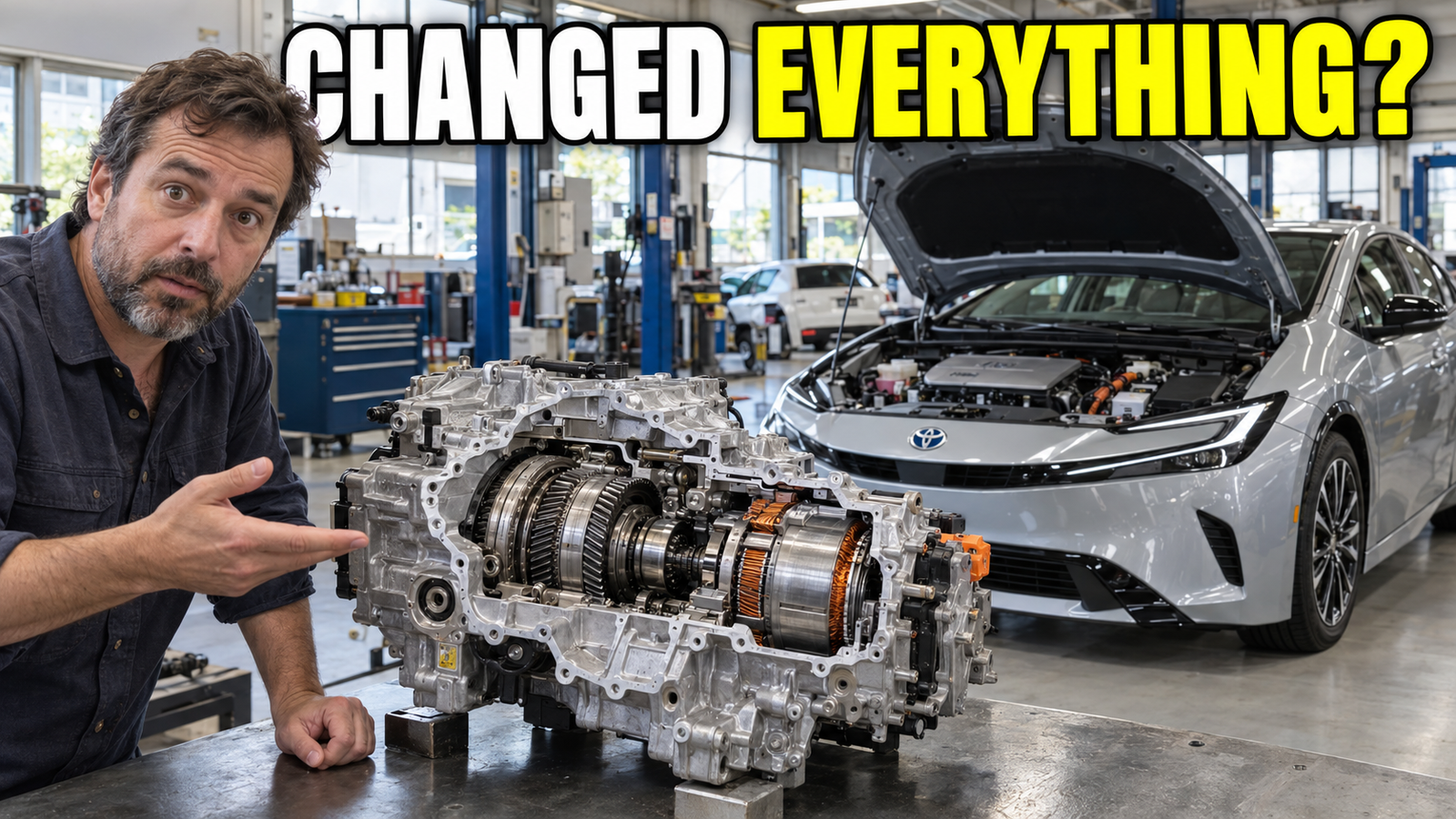
Honda Engineers Tore Down a Toyota Hybrid — What They Found Changed Everything
There is something fascinating about what happens when you look beneath the hood of a Toyota hybrid.
At first glance, a Prius does not seem particularly remarkable. It has a gasoline engine, an electric motor, a battery, and the kind of everyday practicality that has made Toyota one of the biggest names in the automotive industry.
But start examining how those components work together, and you begin to understand why the company has been so difficult for competitors to challenge.
The real secret is not a revolutionary battery, an unusually powerful engine, or some expensive piece of futuristic technology.
It is how Toyota manages energy.
That is what makes the engineering story behind Toyota and Honda so interesting. Both companies have spent decades chasing the same goal: making gasoline engines use less fuel without sacrificing everyday usability.
Yet they approached the problem in surprisingly different ways.
Honda’s own historical records reveal just how seriously its engineers studied the competition, including moments when Toyota’s developments caught them off guard. Although there is no verified public account of a single Honda teardown that transformed its hybrid strategy overnight, the actual engineering rivalry reveals something arguably more important.
The most effective hybrid is not necessarily the one with the most complicated technology.
It is the one that wastes the least energy.
The Toyota Hybrid System Is More Clever Than It Looks
To understand Toyota’s advantage, start with the transmission.
A conventional automatic transmission uses gears and other mechanical components to deliver engine power to the wheels at different speeds.
Toyota’s hybrid system works differently.
Inside its hybrid transaxle is a compact mechanical device called a planetary gearset. Rather than simply changing gears like a traditional automatic transmission, this arrangement helps distribute power between the gasoline engine, an electric generator, and the wheels.
It is an elegant solution to a difficult problem.
Gasoline engines do not operate at maximum efficiency under every condition. They typically waste more energy when forced to run in operating ranges that are poorly suited to the amount of power being requested.
Electric motors have different strengths.
They can deliver torque immediately, operate efficiently at low speeds, and recover some of the energy normally lost during braking.
Toyota designed its hybrid powertrain to take advantage of both.
When the car is moving slowly, the electric motor can handle propulsion while the gasoline engine remains off.
When additional power is required, the engine starts and contributes energy.
During braking, the electric motor works as a generator, recovering energy that would otherwise become heat in the brakes.
The planetary power-split arrangement makes it possible to manage these functions without relying on a conventional multi-speed automatic transmission.
That is why Toyota’s hybrid system can feel remarkably smooth in everyday driving.
The driver does not have to decide when to use electricity or gasoline. The computers handle that continuously.
And much of the system’s efficiency comes from making those decisions correctly.
The Battery Is Not What Makes a Prius Special
One of the most common misunderstandings about hybrid vehicles is that their efficiency comes primarily from having a large battery.
In Toyota’s conventional hybrids, that is not the case.
The battery is relatively small compared with the enormous packs found in fully electric vehicles.
Its purpose is not to provide hundreds of miles of electric-only driving.
Instead, it stores enough energy to help the vehicle accelerate, operate electrically under suitable conditions, and recover energy during deceleration.
The engine and battery continuously support each other.
This is an important distinction because batteries add cost and weight.
A larger battery can store more energy, but it is not automatically the best solution for a vehicle designed around gasoline efficiency.
Toyota has spent decades refining how much battery capacity its hybrids actually need.
The result is a powertrain that can achieve excellent fuel economy without carrying the weight or expense of a large electric vehicle battery.
For 2026, the Toyota Prius uses the fifth-generation Toyota Hybrid System, combining a 2.0-liter gasoline engine with electric propulsion.
The front-wheel-drive model produces 194 combined horsepower, while the all-wheel-drive version delivers 196 horsepower.
Toyota estimates that the most efficient front-wheel-drive configuration can achieve up to 57 miles per gallon combined.
Those are impressive numbers for an everyday vehicle that does not require plugging in.
But Toyota did not develop this technology in isolation.
Honda was chasing similar improvements long before hybrids became mainstream.
Honda’s First Approach Was Completely Different
The rivalry between Honda and Toyota goes back to the earliest days of mass-produced hybrids.
Toyota introduced the original Prius in Japan in 1997.
Honda followed with its first-generation Insight in 1999.
Although both vehicles combined gasoline and electric power, they used very different approaches.
Honda’s original Integrated Motor Assist system, commonly known as IMA, placed an electric motor alongside a small gasoline engine.
The motor provided assistance during acceleration and recovered energy through regenerative braking.
It was lightweight, relatively compact, and suited Honda’s obsession with mechanical efficiency.
The original Insight was an extraordinary engineering achievement.
Its lightweight aluminum construction, aerodynamic body, and small engine helped it deliver remarkable fuel economy.
But Honda’s system had a significant limitation.
In the original Insight, the gasoline engine remained central to propulsion. The electric motor primarily assisted the engine rather than independently powering the car through ordinary electric-only driving.
Toyota’s Prius could rely more heavily on electric propulsion under suitable conditions.
That difference became increasingly important as hybrid technology evolved.
Toyota had built a system capable of seamlessly combining mechanical and electrical power through its planetary gear arrangement.
Honda had developed a lighter, simpler engine-assist solution.
Neither approach was universally superior in every engineering respect, but Toyota’s architecture offered flexibility that became particularly valuable in practical passenger cars.
Honda eventually moved toward a fundamentally different solution.
And the company’s own account of that development contains a revealing detail.
The Discovery That Surprised Honda’s Engineers
In Honda’s official history of hybrid development, engineers describe the intense technical competition that existed between the two Japanese manufacturers.
One particular episode occurred in 2011.
Honda was developing a new motor design using rectangular copper conductors to improve how efficiently the motor could be packaged.
The technology was intended to make future hybrid motors smaller while increasing their performance.
Then Toyota introduced the Aqua, a compact hybrid sold in other markets under the Prius c name.
Honda’s engineers discovered that Toyota had adopted a motor concept remarkably similar to the design they were working on.
According to Honda’s historical account, the similarity surprised the development team.
The discovery created additional challenges involving manufacturing methods and intellectual property considerations.
Honda continued developing its own motor technology, eventually introducing more compact and powerful systems.
This episode does not establish that Honda copied Toyota or that a specific teardown caused a redesign.
What it does reveal is the intensity of the competition.
Engineers at both companies were searching for similar improvements in efficiency, packaging, and electric motor construction.
And Toyota’s progress was significant enough to surprise people working on competing technology.
That is the kind of pressure that changes how an engineering organization thinks.
Honda Found a Different Way to Solve the Same Problem
Honda’s eventual breakthrough came from questioning whether a hybrid vehicle really needed the kind of transmission architecture its engineers had originally planned.
During development of its more advanced two-motor hybrid system, Honda struggled to package the necessary components efficiently.
The original concept included a continuously variable transmission alongside electric motors responsible for propulsion and generation.
But adding more hardware created packaging and efficiency challenges.
Honda’s engineers eventually arrived at a strikingly simple idea.
Instead of trying to fit all those components into the available space, they would remove much of the traditional transmission mechanism.
The resulting system used two electric motors with different responsibilities.
One motor primarily drives the wheels.
The other works with the gasoline engine to generate electricity.
During much of everyday driving, the propulsion motor is responsible for moving the vehicle.
When the gasoline engine operates, it can generate electricity that powers the drive motor or replenishes the battery.
At appropriate cruising speeds, a clutch allows the engine to drive the wheels mechanically, avoiding unnecessary energy conversion losses.
Honda called its early production version Intelligent Multi-Mode Drive, or i-MMD.
The technology later evolved into the e system used in modern Honda hybrids.
Unlike Toyota’s planetary power-split approach, Honda’s architecture generally emphasizes electric propulsion during urban driving and direct mechanical engine drive when conditions make that more efficient.
It achieves a similar overall objective through a different mechanical arrangement.
Honda had not simply recreated Toyota’s hybrid system.
It had developed its own answer.
Why the Difference Matters in Real Driving
Imagine driving through a busy city during the morning commute.
Traffic moves slowly. Cars repeatedly accelerate, stop, and accelerate again.
A conventional gasoline engine spends much of that journey operating under conditions that are not particularly efficient.
A modern hybrid uses electric propulsion and regenerative braking to reduce those losses.
Toyota’s system continuously manages the relationship between engine power, electric generation, and wheel propulsion.
Honda’s two-motor system often uses the electric drive motor to provide the driving force, while the engine operates as a source of electrical energy when needed.
On the highway, the priorities change.
At a steady cruising speed, directly using engine power can be more efficient than converting that power into electricity and then converting it back into mechanical movement.
Honda’s system uses a mechanical connection during suitable cruising conditions.
Toyota’s power-split arrangement can also transmit engine power mechanically while managing electrical power flow.
Both systems have sophisticated controls to determine how to use their available energy.
For drivers, the result is straightforward.
Better fuel efficiency without having to learn a completely different way to drive.
That is arguably the most important reason conventional hybrids have remained appealing.
They provide meaningful reductions in fuel consumption while preserving the familiar experience of owning a gasoline-powered car.
Toyota Has Spent Decades Eliminating Small Losses
One of the most revealing things about Toyota’s hybrid engineering is how much attention the company gives to seemingly minor sources of inefficiency.
Consider the fourth-generation Prius, introduced for the 2016 model year.
Toyota redesigned the hybrid transaxle, electric motors, and associated mechanical components.
According to Toyota’s own engineering information, changes to the transaxle helped reduce mechanical losses by approximately 20 percent compared with the previous design.
The improvement did not come from installing an enormous new battery.
It came from reorganizing components, reducing friction, improving motor packaging, and refining the way mechanical power moved through the system.
The gasoline engine was also extensively improved.
Toyota reported that the redesigned 1.8-liter engine achieved a maximum thermal efficiency of 40 percent.
That figure is significant because ordinary gasoline engines lose a substantial portion of their fuel’s energy as heat.
Improving thermal efficiency means extracting more useful work from the same amount of fuel.
In a hybrid vehicle, those improvements become especially valuable because the electric system can help keep the engine operating under favorable conditions.
Reducing a little friction here, improving combustion there, and recovering more braking energy may not sound exciting individually.
Together, those changes make a substantial difference.
That is the real discipline behind an efficient hybrid.
Honda’s Newest Hybrids Show How Far the Rivalry Has Come
Honda’s modern hybrid vehicles demonstrate how much the company learned through its own engineering development.
The latest two-motor hybrid architecture powers vehicles including the Accord, CR-V, Civic, and revived Prelude.
Honda has continued improving motor performance, reducing component size, and optimizing the relationship between engine operation and electric propulsion.
The 2026 Honda Civic Hybrid sedan, for example, carries an EPA-estimated combined fuel economy rating of 49 miles per gallon.
That is a substantial improvement over the conventional gasoline Civic, while offering strong acceleration and everyday practicality.
Honda has also refined the packaging of its electric motors and developed systems capable of operating efficiently across a wider range of conditions.
In January 2026, Honda reported that it had sold more than one million vehicles equipped with its two-motor hybrid system in the United States over the preceding 12 years.
That milestone matters because the technology was no longer an experimental alternative for a small number of enthusiasts.
It had become a mainstream part of Honda’s vehicle lineup.
Toyota and Honda now compete with mature hybrid architectures that represent decades of development.
Both have demonstrated that excellent fuel economy does not necessarily require a massive battery or fully electric drivetrain.
And both continue refining their systems rather than treating hybrid development as finished.
What a Toyota Hybrid Teardown Really Reveals
If an engineer were to dismantle a modern Toyota Prius powertrain, the most important discovery would not be a secret component capable of transforming the automotive industry overnight.
It would be the way the entire system has been engineered to work together.
The planetary gearset manages mechanical relationships between the engine, motor, and generator.
The electronics continuously monitor operating conditions and manage power flow.
The battery stores recovered energy and supplies assistance when needed.
The gasoline engine is designed to prioritize efficiency rather than deliver maximum performance on its own.
And each major component has been refined to reduce weight, friction, packaging demands, and unnecessary energy losses.
None of these features is magic.
The achievement lies in how carefully they have been integrated.
Honda’s engineering evolution highlights the same principle from a different direction.
Its engineers pursued efficiency by simplifying the transmission arrangement, emphasizing electric motor propulsion, and using the gasoline engine directly when that made more sense.
The two companies reached similar goals through different technical decisions.
That is what makes their rivalry so valuable to the automotive industry.
It forces both manufacturers to keep asking whether there is a more efficient way to build the same vehicle.
The Real Lesson Behind Toyota’s Hybrid Success
The temptation is to imagine that every major automotive breakthrough begins with engineers finding a mysterious component hidden inside a competitor’s vehicle.
The reality is usually less dramatic and more interesting.
Toyota’s hybrid advantage was built through decades of careful engineering, manufacturing experience, and relentless attention to efficiency.
Honda’s response was shaped by its own research, technical discoveries, and determination to develop a competitive system with a different mechanical philosophy.
The rivalry produced more efficient motors, smaller components, better control software, and powertrains that ordinary drivers can use without changing their habits.
Honda’s documented surprise at Toyota’s motor technology shows how closely these two manufacturers have competed.
Its later two-motor breakthrough demonstrates how a company can study the same engineering problems and arrive at a different solution.
And a close look at Toyota’s hybrid powertrain explains why the Prius became such an influential vehicle.
It was never simply about putting a battery next to an engine.
It was about understanding when each source of power works best, and designing an entire vehicle around that principle.
That may not sound as dramatic as discovering a hidden defect or revolutionary new invention.
But it explains something far more important.
Toyota showed the automotive industry how much efficiency could be gained by making two power sources work together. Honda proved there was more than one way to get there.
And decades later, both companies are still finding ways to improve the formula.