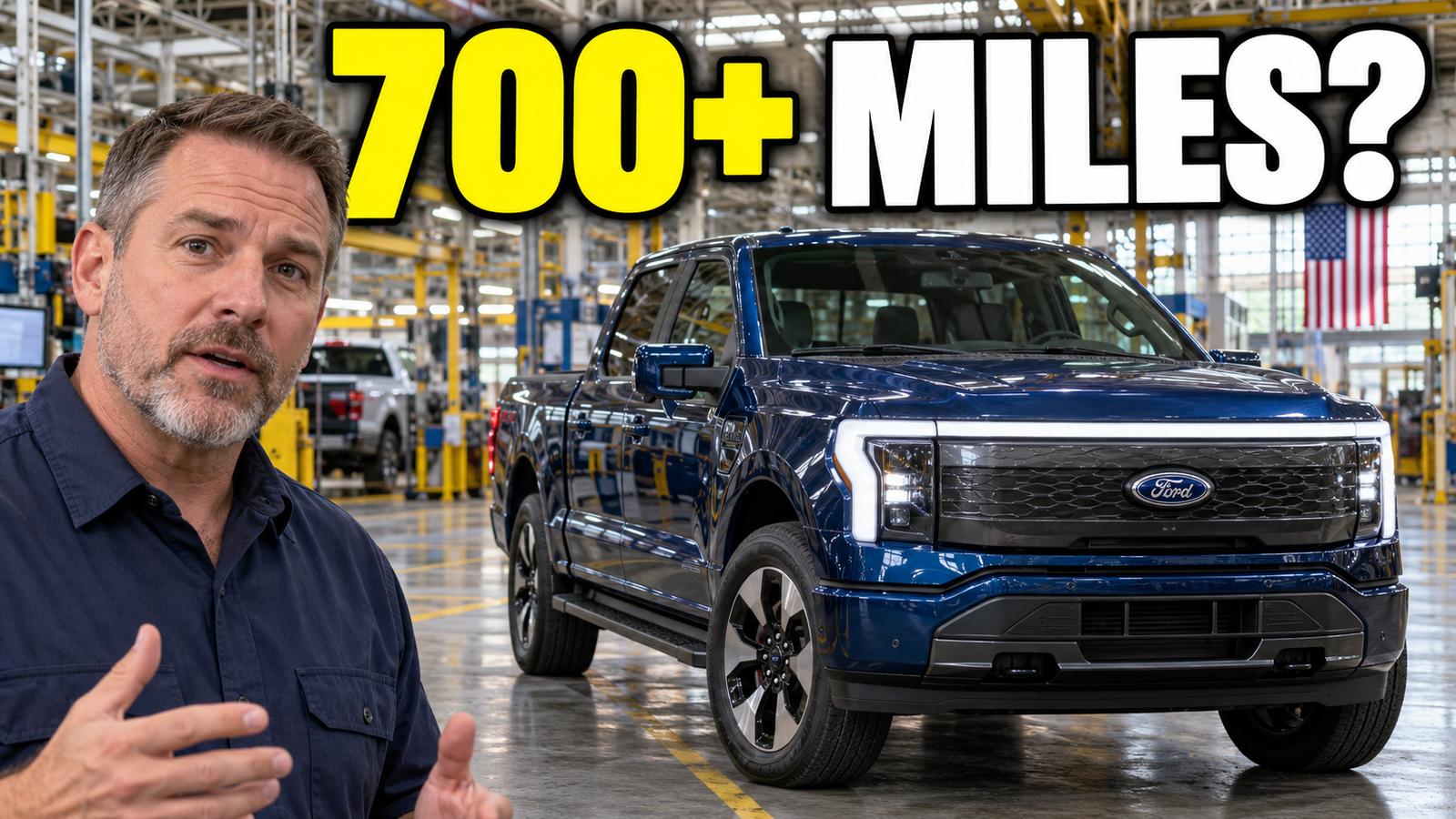
Ford BLOWS UP the Entire Electric Truck Industry With Latest F-150 Lightning Announcement!
Ford has delivered one of the biggest reversals in the electric pickup business. After spending years promoting the F-150 Lightning as proof that America’s favorite truck could run entirely on batteries, the automaker has decided its next Lightning will take a different approach.
The original battery-electric truck is no longer in production. In its place, Ford has announced an extended-range electric vehicle, or EREV, targeting more than 700 miles of total driving range.
That figure is Ford’s estimate for a future model, not a verified result from a production truck. Still, the decision says plenty about what Detroit has learned.
The Lightning launched in 2022 with genuine strengths. It was quick, quiet and remarkably useful, with a spacious front trunk and available onboard power for tools or even home backup. But impressive technology could not erase the compromises facing buyers who regularly tow heavy trailers or travel far from reliable charging stations.
A large battery costs money and adds weight. Towing can sharply reduce driving range, while finding a charging station that accommodates a pickup and trailer is not always easy. For customers accustomed to filling a gasoline tank in minutes, the adjustment was substantial.
Ford also faced the financial realities of building an expensive electric truck for a market smaller than initially expected. In December 2025, it confirmed that production of the first-generation Lightning had ended as part of a wider restructuring of its electric-vehicle plans.
The replacement is where things get interesting.
Unlike a conventional hybrid, the upcoming Lightning EREV will use electric motors to drive the wheels. A gasoline engine will operate as a generator, producing electricity when needed rather than mechanically powering the truck.
In everyday driving, owners could enjoy the smooth acceleration and quiet operation associated with electric propulsion. On longer trips, the generator would help extend the journey without depending entirely on public fast chargers.
Ford says the truck is being engineered for demanding towing, rapid acceleration and the ability to supply electricity to tools, campsites or homes during outages. Its projected total range exceeds 700 miles.
For truck owners, that combination could be compelling. Someone who charges at home might drive electrically for much of the week, then use gasoline-backed range for a long trip with a trailer.
But there are unanswered questions. Ford has not announced a firm launch date, final pricing, battery-only driving range or independently tested towing efficiency. A generator also introduces fuel consumption, maintenance needs and added mechanical complexity. The new Lightning will not be a fully battery-electric pickup.
The announcement matters beyond Ford because Chevrolet and Ram face similar questions about the cost and practicality of electrifying full-size trucks. Large batteries can deliver extraordinary capability, but they also push prices higher. Customers want the benefits of electric power without giving up the convenience they already have.
Ford is effectively admitting that one powertrain cannot satisfy every pickup buyer. Alongside the future Lightning, it is developing smaller, more affordable fully electric vehicles.
That may be the real turning point. The company is no longer asking truck owners to adapt completely to an electric pickup. It is trying to make the pickup adapt to the way Americans actually use their trucks.
Whether the next Lightning succeeds will depend on price, reliability and real-world performance. But Ford’s announcement has already changed the argument: the future of electric trucks may involve more than batteries alone.